Over the last couple of months, I’ve been experimenting with quizzes as a tool for quickly filling your lead warehouse. A quiz, in combination with Facebook ads, can be a great source of leads at a relatively low cost for info businesses.
Therefore, quizzes can be a great entry point for your funnel if you know how to segment, nurture & convert leads.
The key is to;
-
quickly transition them from quiz to the actionable step (i.e. membership, tripwire, free+shipping offer, etc.)
-
invest in additional pre-framing campaigns (i.e. if you’re paying $0.60 per lead, invest additional $0.30 in pre-framing > total cost = $0.90)
-
engage newly acquired leads with strong follow-up sequence (email, chatbot)
Note that the lead cost will heavily depend on the market size. You can always expect to get leads at a lower cost in a big market than in a small one.
This approach can work for coaches, consultants & info-based businesses which sell problem-oriented programs or courses, while it probably WON’T work for e-commerce (If you prove me wrong, you have a beer on my tab)…
By the time you‘re done with reading, you’ll be ready to run your own Quiz Funnel with Facebook ads.
LESSON 1 —Understand Who’s Solving The Quiz
Everything starts with the market. Knowing WHO buys your products or services will always put you one step ahead of the competition. If you know who’s buying, the next step is to find a way to target them on Facebook.
You can easily find your target audience by playing around with interests and behaviours in Audience Insights. Have a customer list? Even better, just upload it and see how to reach people similar to your previous buyers.
By using Audience Insights you can find out;
- which pages do your target audience likes
- where do they live
- how active they are on Facebook
- what’s their (household) income (available for theUS only)
- on what do they spend money (available for the US only)
Once you have a solid idea of who you’re going to target and how is that aligning with what you’re selling, it’s time to start thinking about the quiz itself.
The most important part of the quiz is the headline (Remember that 80% of people only read the headline)— which should propose a problem which can be “solved” if a person takes the quiz. Couple of general examples;
- Selling teeth whitening product to M/F, 25–50 — Do I Need Teeth Whitening?
- Selling dresses to F, 18–35 —* How To Choose The Perfect Date-Night Dress?*
- Selling weight loss course to F, 35–65 — Why Do I Return Every Pound I Lose?
The best way to decide on the headline is to split test. Write a couple of headlines, each from a different angle & see which one is going to give you the lowest cost-per-lead and the highest offer take rate.
Repeat the process until you get the KPIs which suit your projections.
LESSON 2— Define The Funnel Strictly
The flow of the funnel should feel natural. The goal of every step of the funnel is to get the prospect to take action FAST & move to the next step.
First, you get them to click on the ad and then get to the Quiz Landing Page which should only be consisted of the headline, sub-headline and simple CTA such as “Start The Quiz”.
Then you have the Quiz, which should consist of no more than 10 simple questions (ideally 6–8), which will take 2–3 minutes to solve.
The next step is Quiz Results Page which gives an outcome based on the answers they’ve given. You’re going to have 2–4 possible outcomes which translate into** 2–4 custom outcome pages**.
The goal of this step is to explain the outcome & propose a quick solution to the “problem”. The best way to do this is with a short video (again, by outcome) which has one goal —moving them to the Offer Landing Page.
Keep in mind that the offer should be simple, “irresistible” and must not cost more than a coffee for two, or in other words — not more than $9.99. You can also give something for free (But then there’s no chance to get a break-even on the leads).
Anyway, here’s a couple of ideas;
- Free Membership
- Free 30-Day Trial
- Free + Shipping ($9.95)
- Tripwire (up to $9.95)
- Free Consulting Session
Bonus tip: Integrate social proof in the form of testimonials on the offer landing page to boost credibility. Whoever takes the quiz knows you for max. 5 minutes — they have no reason to trust you. Give them some.
If they decide to take your offer, the next step is Offer Thank You Page which should give them the outcome based on the Offer.
If you offered them a free membership, you’ll give them the Facebook group link & ask them to subscribe to the chatbot sequence & let them know that you’re going to be sending emails to them.
The key to success is to get prospects move to the next step FAST & invest in interacting with them again through an email sequence, chatbot sequence & Facebook retargeting. Otherwise, you’ll lose their attention & they won’t even remember they took the quiz 24 hours later.
Tools Used To Build The Funnel:
- Clickfunnels
- Lead Quizzes
- Active Campaign
- Manychat
- Zapier
LESSON 3— Know Your KPIs
“It’s a matter of timing. Selling is like a seduction. If you ask a woman to go to bed with you, whether or not she’s going to say ‘yes’ is largely a matter of when you ask her.”
— Gary Halbert
The same rule applies if you ask for an email. When you ask for an email is going to directly affect the opt-in rate. You can ask;
- Before the quiz (On the Quiz Landing Page)
- Before you give them results (Before the Quiz Results Page)
- Before they take the offer (On the Offer Landing Page)
There’s not much wisdom here — the sooner you ask, you’re going to get more leads (at a lower cost), but they’re going to be less qualified. The best way to decide on this matter is to split test and see which one gives you the best ratio between the cost-per-lead and the offer take rate.
You can track your KPIs by step with Facebook Analytics and/or an excel sheet. I usually go with Facebook Analytics because it requires less manual work & does a great job of visualizing data (definitely better than excel).
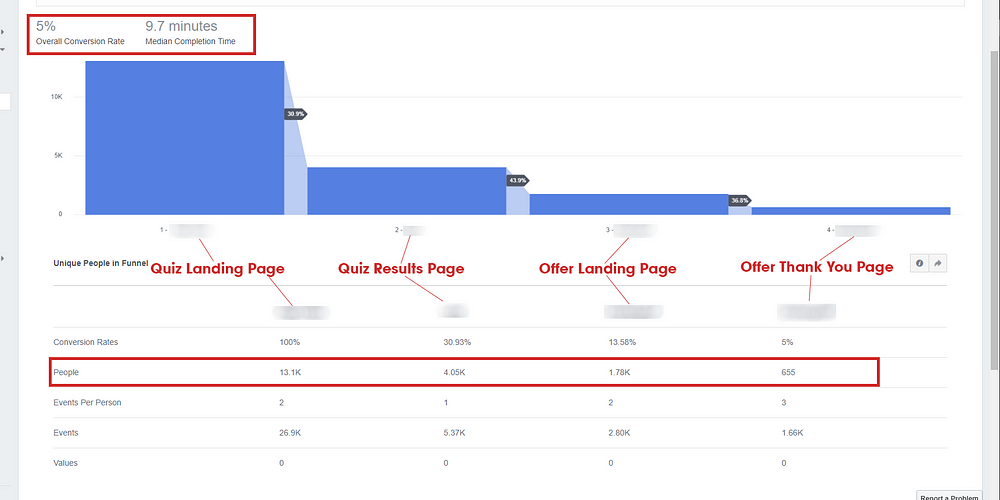
For this specific funnel, we asked for the email before the Quiz Results Page, while the offer was a $4.97 e-book with Free Group Membership included.
Here are the results we got after 72 hours of run time;
- 13.1K people entered the Quiz Landing Page
- 4.05K people got to the Quiz Results Page (30.93%)
- 1.78K people got to the Offer Landing Page (43.95%)
- 655 people took the offer and got to the Offer Thank You Page (36.79%)
- 448 people joined the Free Facebook Group (68.39%)
- 394 people subscribed to Chatbot Sequence (60.15%)
Again, this worked because the offer was simple to understand, “irresistible” (quick solution to the proposed problem) & it costed $4.97 which is a complete no-brainer. The offer has to be aligned with the target audience, otherwise, it WON’T work, period.
LESSON 4 —Be specific with Facebook Ads
You know now everything to get the Quiz Funnel done, it’s time to launch the ads. The first thing on the list is to get a winning ad which converts. Since we discussed that in STEP 1, there’s no need to do it again.
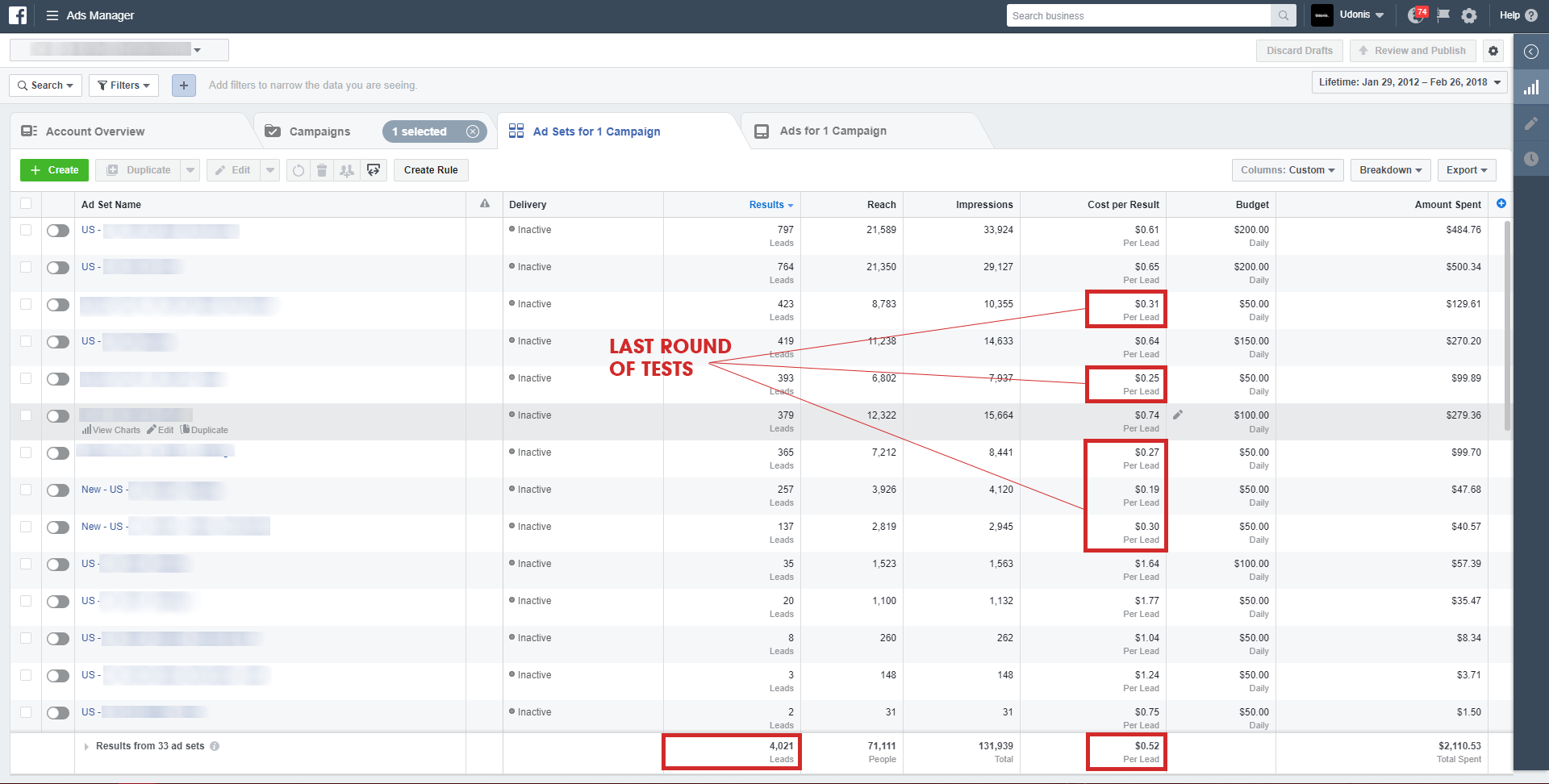
Here’s how finding the winning ad looked like;
Once you have a winning ad, progress forward to narrowing down to the right audience to get as low as you can on the lead price and as high as you can with the offer take rate. You’ll do this by split testing different interests, behaviours, lookalikes or custom audiences & playing around with bidding strategy.
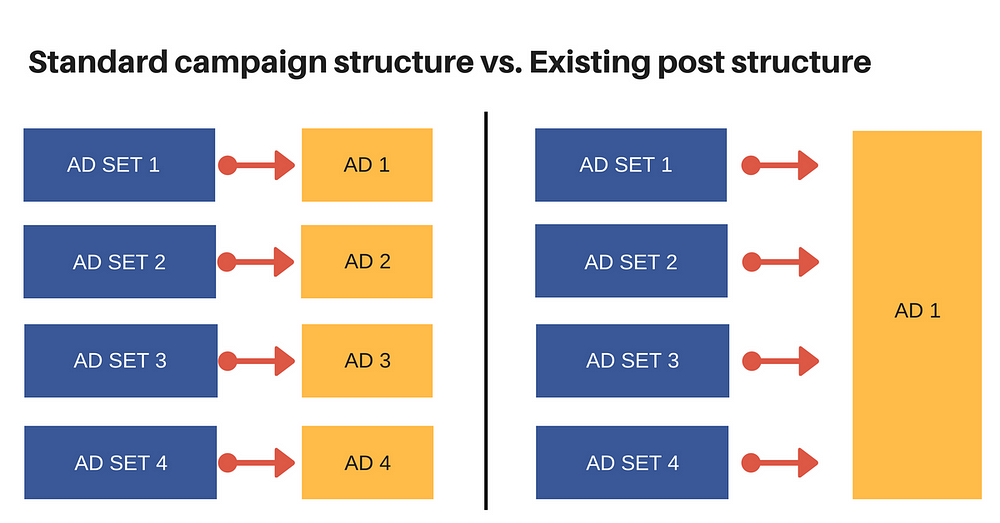
To make the split testing process more efficient & accurate, you’re going to point all traffic (from multiple ad sets) to a SINGLE ad. That way you’re not wasting money to build social proof on 10, 20 or 50 different ads to see if something works or not. The process behind this is simple;
- create one ad set containing the winning ad
- copy the winning ad/post ID
- insert the ad/post ID into other ad sets by using “Use Existing Post” option
The next step is to decide on the budget & time per test. We usually go with 2–4X the goal CPA per test, even though even 1X the goal CPA per test is enough on seasoned accounts, while the test length varies from account to account (in most cases 48–72 hours).
Since the goal CPA (in this case CPL) was to go under $1, we could have settled with a $2/day budget, but that was to slow for us since we needed to complete the campaign within 72 hours. We started off each ad set with $50/day and quickly scaled each ad set which showed potential (and killed those which didn’t perform within a couple of dollars spent).
The aftermath;
- Total ad spend — $2,110.53
- Total number of leads — 4,021
- Total cost per lead — $0.52
- Total number of offers taken — 655
- Total cost per offer taken —** $3.22**
- Revenue generated from the offer —** $3,255.35**
- Profit per offer taken — $1.75
- Gross profit — $1,144.82
Next Steps…
Sticking to lessons I’ve outlined can get you low-cost leads. The next step is to convert them with a good offer to break even (or even earn a small profit). From that point on, everything should be pure profit, so continue engaging with them through 4 channels they subscribed to:
- Chatbot
- Facebook group
- Facebook retargeting
Final tip: Since you’re getting leads at a very low cost, it’s good to invest in branding campaigns. That way you’re establishing stronger authority over the acquired audience to pre-frame them for the up-sell.
[link] [comments]
from Entrepreneur http://ift.tt/2FaCJYI
via IFTTT
add adsense to blogger
how much money do bloggers make? can blogs make money? make money off ads how to get money from blogging? best websites to make money blog adsense income earn from blogging website ideas to make money how websites make money?



No hay comentarios.:
Publicar un comentario